Guide
How can I track my Parkinson's tremor and dyskinesia all day?
Wear an Apple Watch (Series 4 or newer, on watchOS 10 or later) with the Kampa watch app installed. The watch records tremor and dyskinesia in the background, all day, using Apple's Movement Disorder API, and Kampa shows both on one chart beside your doses, meals and sleep. Kampa is free.
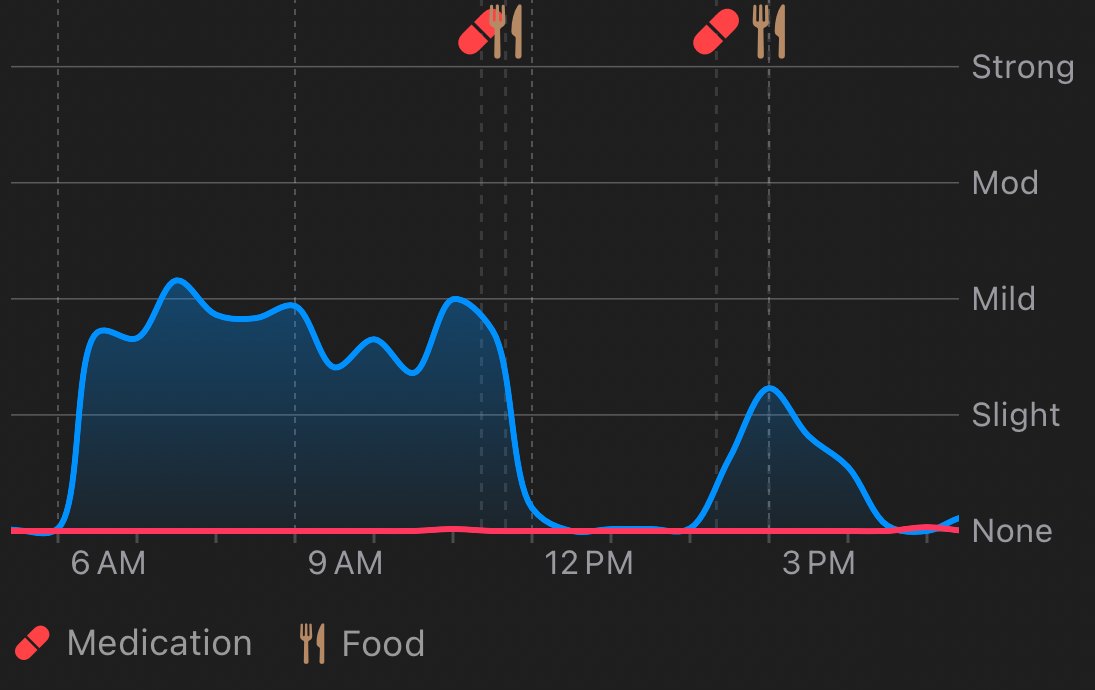
What gets recorded
Tremor, as a None-to-Strong estimate (0 to 4) produced automatically from wrist sensing. Each point on the line is your typical level over about ten minutes, so the chart shows how tremor rises and falls through the day rather than one flattened number.
Dyskinesia - the involuntary movements that can come with levodopa, usually at peak dose. Not everyone has it; if you don't, a flat line is the correct reading.
Both are estimates from one wrist, not a doctor's exam and not a clinical score. Use them to compare your own days against each other.
Can an Apple Watch track Parkinson's symptoms?
Yes - Apple Watch Series 4 and later include Apple's Movement Disorder API, which estimates tremor and dyskinesia from the wrist in the background. An app has to request it; Kampa does, and shows the result beside everything else you log.
How to set it up
- Install Kampa on your iPhone (iPhone 11 or newer, iOS 26 or later).
- Install the Kampa app on your Apple Watch.
- On the watch, turn on Motion & Fitness in Settings → Privacy & Security → Motion & Fitness. Without it the watch returns no tremor readings at all.
- Allow Health access on the iPhone, so Kampa can read your sleep, exercise and medications.
- Wear the watch through your normal days. Patterns need a few days of regular wear.
Reading the chart
Tremor and dyskinesia often move in opposite rhythm: tremor tends to rise as a dose wears off, and dyskinesia at peak dose. Seeing both around your doses on one chart is the levodopa cycle made visible.
A gap in the line means Kampa has no measurement for that stretch - the watch was charging, off your wrist or not yet synced - not that you had no tremor.
Open the app every few days. The watch stores about a week of readings and hands them to your iPhone when the app opens.
What it does not measure
A watch on one wrist cannot measure slowness of movement (bradykinesia), and cannot tell rest tremor from tremor that appears only when you hold a position. Kampa's movement checks - ten-second tests on the phone, each matched to a movement a neurologist checks by hand - cover those.
Kampa is a personal tracking tool, not a medical device, and it never suggests a change to your medication.
No Apple Watch?
Kampa also works on iPhone alone: walking speed, steps and steadiness, sleep and heart-rate variability from Apple Health, the movement checks, and dose timing from the doses you log. What you will not have is the all-day tremor and dyskinesia record. If you add a watch later, it joins the same timeline.
More guides: See how long each dose holds, and the gaps between doses · Keep medication, meals and movement on one timeline · Track Parkinson's with just your iPhone · See whether protein near a dose changes how it works for you · Turn weeks of tracking into a report for your appointment · Keep a record of the weeks your neurologist never sees · What an app records that a diary cannot - and the reverse · Kampa is free, with no subscription or account · Start simple: see how your symptoms change through the day · Log constipation, fatigue, mood and 14 more in one tap · See whether your sleep moves your next-day tremor · See whether each kind of exercise moves your tremor and walking · Log doses with one tap, and meals and symptoms by voice · Log pump settings and see your tremor within each one · Questions to ask before you choose a tracking app
Try it on your own record
Kampa is free on the App Store, with no subscription and no account to create. Questions? info@kampa.health reaches the people who build it.
Kampa is a personal tracking tool, not a medical device. It does not diagnose, treat or give medical advice, and it never suggests a change to your medication.